


Related

Portfolio Strategies
To better understand the Wagner Revised screen's outperformance in 2025, it is useful to look beyond headline returns and examine the characteristics and stocks that drove results.

The Wanger Revised screen delivered strong performance in 2025, gaining 65.9% year to date through December 12, compared to a 10.3% gain for exchange-listed stocks overall. To better understand this outperformance, it is useful to look beyond headline returns and examine the characteristics and stocks that drove results.
Companion articles to the 2025 Review of AAII Stock Screens
Ralph Wanger outlined his investing strategy in his book “A Zebra in Lion Country.” His approach focuses on identifying overlooked, high-quality small-cap companies by deliberately standing outside the investment “herd.” Wanger believes smaller companies offer superior long-term return potential because they tend to be more nimble, easier to understand and owner-managed, and they possess greater room for growth than larger firms. At the same time, he avoids excessive risk by excluding micro-caps, start-ups, initial public offerings (IPOs) and turnarounds, favoring established businesses with at least five years of trading history, sound balance sheets and proven management teams.
His strategy rests on a “three-legged stool” of growth potential, financial strength and reasonable valuation. Growth is driven by long-term social, economic or technological themes that unfold over several years rather than short-term forecasts. Wanger prefers downstream beneficiaries or companies with durable niche dominance. Strong market positioning is identified through above-average, sustainable operating margins and consistent sales growth relative to industry peers.
For financial strength, Wanger favors companies with low leverage, adequate working capital and reliable operating cash flow, evaluating balance-sheet risk relative to industry norms to reduce downside exposure. For valuation, Wanger seeks strong businesses that are attractively priced. In doing so, he emphasizes growth at a reasonable price—particularly through price-earnings (P/E) ratios evaluated in the context of earnings growth—while avoiding extremes that signal either unsustainable growth or potential value traps.
Wanger is a long-term investor who minimizes trading, monitors holdings against their original investment thesis and allows winners to run. He stresses diversification and encourages investors to adopt a disciplined approach aligned with their own understanding and temperament. Together, these principles combine contrarian thinking, thematic growth, financial conservatism and valuation discipline to exploit inefficiencies in the small-cap market—where patience and selectivity matter most.
Only a limited number of stocks passed the Wanger Revised screen during 2025. Although the screen remained fully invested throughout the year, it generated an average of just eight passing companies per month, identifying 24 unique stocks in total. Historically, the strategy has produced a much smaller opportunity set than most AAII Stock Screens, averaging only two passing stocks per month since inception, compared to roughly 15 for the typical AAII screen dating back to 1998. While concentrating investments in fewer stocks can amplify returns, it also increases volatility, as performance becomes more sensitive to individual stock movements.
The table lists the 24 companies that passed the Wanger Revised screen in 2025, along with their performance during the periods they were held in the hypothetical portfolio, the number of months each stock was included and selected current financial metrics.
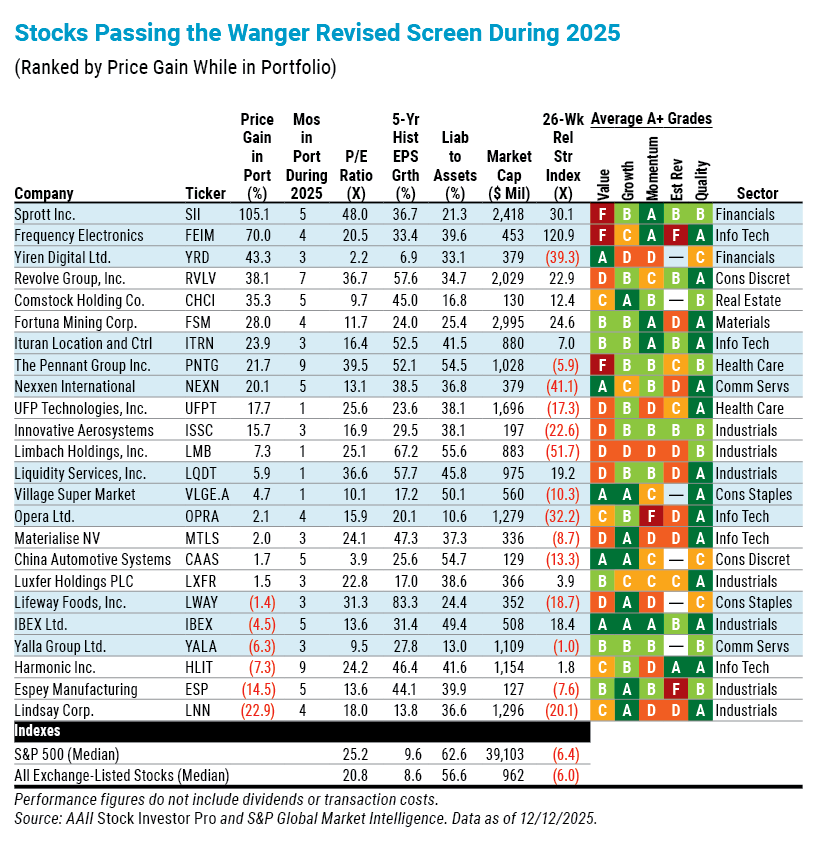
Sprott Inc.  (SII) was the best-performing stock to pass the Wanger Revised screen in 2025, gaining 105.1% and remaining in the portfolio for five months. Sprott is a Toronto-based global asset manager specializing in precious metals and real assets. The stock benefited from rising precious metals and uranium prices, which drove record assets under management (AUM) and strong inflows into Sprott’s physical trusts and exchange-traded funds (ETFs).
When Sprott first passed the screen at the end of February, it had a price-earnings ratio of 22.3 and a historical earnings growth rate of 36.7%, resulting in an attractive price-earnings-to-earnings-growth (PEG) ratio of 0.60. The PEG ratio is a key valuation tool within the Wanger framework. The screen targets PEG ratios below 1.00 while imposing a lower bound of 0.20 to eliminate companies with unsustainably high growth rates or deceptively low valuations driven by weakening fundamentals.
The Pennant Group Inc. (PNTG) passed the Wanger Revised screen for nine months of 2025, delivering a gain of 21.7%. Consistent with Wanger’s emphasis on financial strength, the screen avoids marginal or underfunded companies, favoring those capable of sustaining growth over time. Pennant Group met this criterion, with a total-liabilities-to-assets ratio of 54.1% when it first passed the screen at the end of February—below the industry median of 60.6%.
Because appropriate leverage varies by industry, the Wanger Revised screen evaluates balance sheet strength relative to peers using the ratio of total liabilities to assets as a broad measure of financial risk. To ensure sufficient liquidity, the screen also requires a current ratio above 1.0 for the most recent fiscal quarter and for each of the past three fiscal years. In addition, it requires positive operating cash flow over the last 12 months and in each of the previous three fiscal years, providing further confirmation of financial strength and earnings quality.
To identify firms with dominant market positions, the screen looks for companies with operating margins above the norm for their industry. Because operating margins are highly industry-specific, the focus is on relative rather than absolute levels. Current passing company Ituran Location and Control Ltd. (ITRN) has an operating margin of 21.2%, exceeding both its three-year average of 20.6% and the industry median of 2.8%.
Sales growth provides an additional check on competitive strength. The Wanger Revised screen requires positive annualized sales growth over the past three years and seeks companies whose sales growth over the last four quarters matches or exceeds their longer-term average and the industry median. Ituran Location’s sales have expanded 20.3% over the last year, above its 7.5% three-year growth rate and 9.9% industry median.
Finally, Wanger emphasizes a disciplined, long-term approach to monitoring and selling stocks. Investors should clearly document the original rationale for each purchase and reassess whether that thesis remains intact as conditions change. Unexpected setbacks warrant review, but if the original premise still holds, price declines may represent buying opportunities. Stocks should be sold only when the investment thesis is no longer valid or the company has fully realized its potential, with a general preference for letting successful investments run rather than selling too early.
Portfolio Strategies

Behavioral Finance


CHARLES M from VA posted 9 months ago:
You need to log in as a registered AAII user before commenting.
Log InCreate an account